
Pre-implementation: Conduct the survey before implementation begins to assess staff knowledge and inform the design of your site-specific intervention
Post-implementation: Conduct the survey 12 months after implementation starts to evaluate changes in departmental practices
Pre & Post implementation survey for Clinicians found below:
→ Google Form Copy
→ Microsoft Form Copy
Barriers to PIVC documentation survey
Purpose
To assess the completeness of PIVC documentation in the medical record for patients attending your health service and identify any inconsistencies
Key Actions
Conduct the PIVC Audit Using the Smart Cannula Best Practice Audit Tool
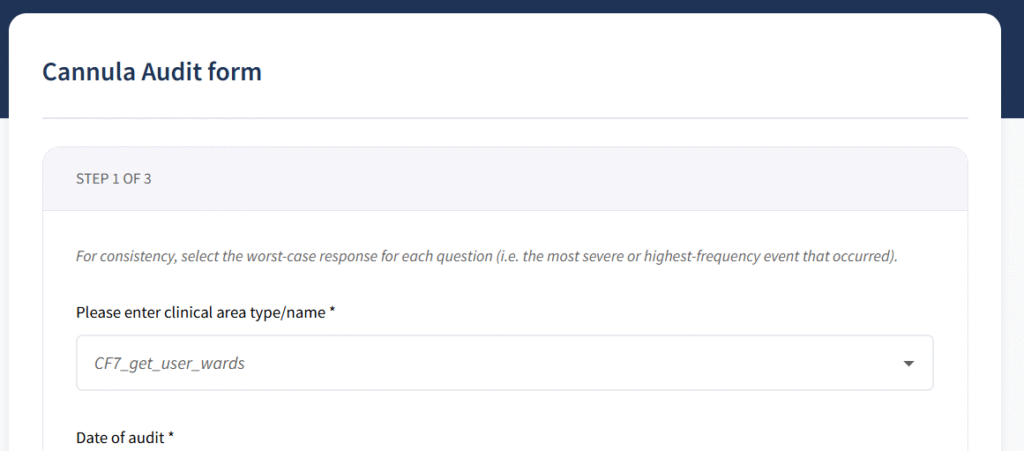
Developed in line with ACSQHC indicators, this tool supports local audits with direct data entry and allows generation of customised report-style report for executive distribution. All data is securely stored within the platform. Click the image below to access the tool.
Calculate the PIVC documentation rate: percentage of “insertion” and any related entries in the medical record for reporting.
Key documents Download and adapt the tool locally
→ Research Protocol – Improving PIVC documentation
→ Data Definitions
→ Data spreadsheet template
Collect HA-SAB data linked to PIVCs
Provide regular audit and feedback to medical directors and nurse unit managers.
HA – SAB definitions
Hospital-associated (HA) Staphylococcus aureus bacteraemia (SAB)Collect data for patients presented in the Emergency Department (ED) | |
Field Name | DEFINITION |
Hospital-associated (HA) Staphylococcus aureus bacteraemia (SAB) | A patient episode of SAB is defined as a positive blood culture for Staphylococcus aureus. For surveillance purposes, only the first isolate per patient is counted, unless at least 14 days have passed without a positive blood culture, after which an additional episode is recorded. Exclusions: Cases where a known previous positive test has been obtained within the last 14 days are excluded. For example, If a patient has SAB in which 4 sets of blood cultures are positive over the initial 3 days of the patient’s admission, only one episode of SAB is recorded. If the same patient had a further set of positive blood cultures on day 6 of the same admission, these would not be counted again, but would be considered part of the initial patient episode. Reference: National Staphylococcus aureus Bacteraemia Data Collection (NSABDC) definition, here |
PIVC Associated – HA Staphylococcus aureus bacteraemia (SAB) | A case of PIVC-associated SAB was defined as a health care-associated SAB in a patient:
Reference: Stuart RL et al.. Peripheral intravenous catheter-associated Staphylococcus aureus bacteraemia: more than 5 years of prospective data from two tertiary health services. Med J Aust. 2013;198(10):551–553, here |
Sharing Best Practice PIVC Information and Statistics
Provide site-specific PIVC data and best-practice information to the site’s Medical Director and nurse unit managers.
Reports can be generated using the Smart Cannula Best Practice Audit Tool and presented regularly to support ongoing monitoring and improvement.
Email template to medical directors and nurse unit managers.

Purpose: Enhancing accessibility of PIVC equipment for clinicians through audit and optimization of the IV trolley.
Key Actions
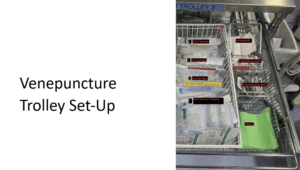
Audit the IV trolley, ensuring drawers are designated exclusively for IV insertion and venepuncture.
Develop a checklist to guide clinical staff in correctly stocking the trolley. Venepuncture Trolley Layout example